ElevenLabs V3, Synthflow TTS, MCP Servers, Outbound Number Pooling & more
May was a busy month at Synthflow: ElevenLabs V3 landed with inline audio tags, a new in-house voice model went live, agents can call out to MCP servers, outbound campaigns can rotate caller IDs, and much more.
If you missed April, it brought SSO, in-call SMS and WhatsApp, a Zendesk knowledge base integration, smarter call transfers, an EU customer region, and plenty more.
Let's dive into what's new.
Elevenlabs V3 with Audio tags
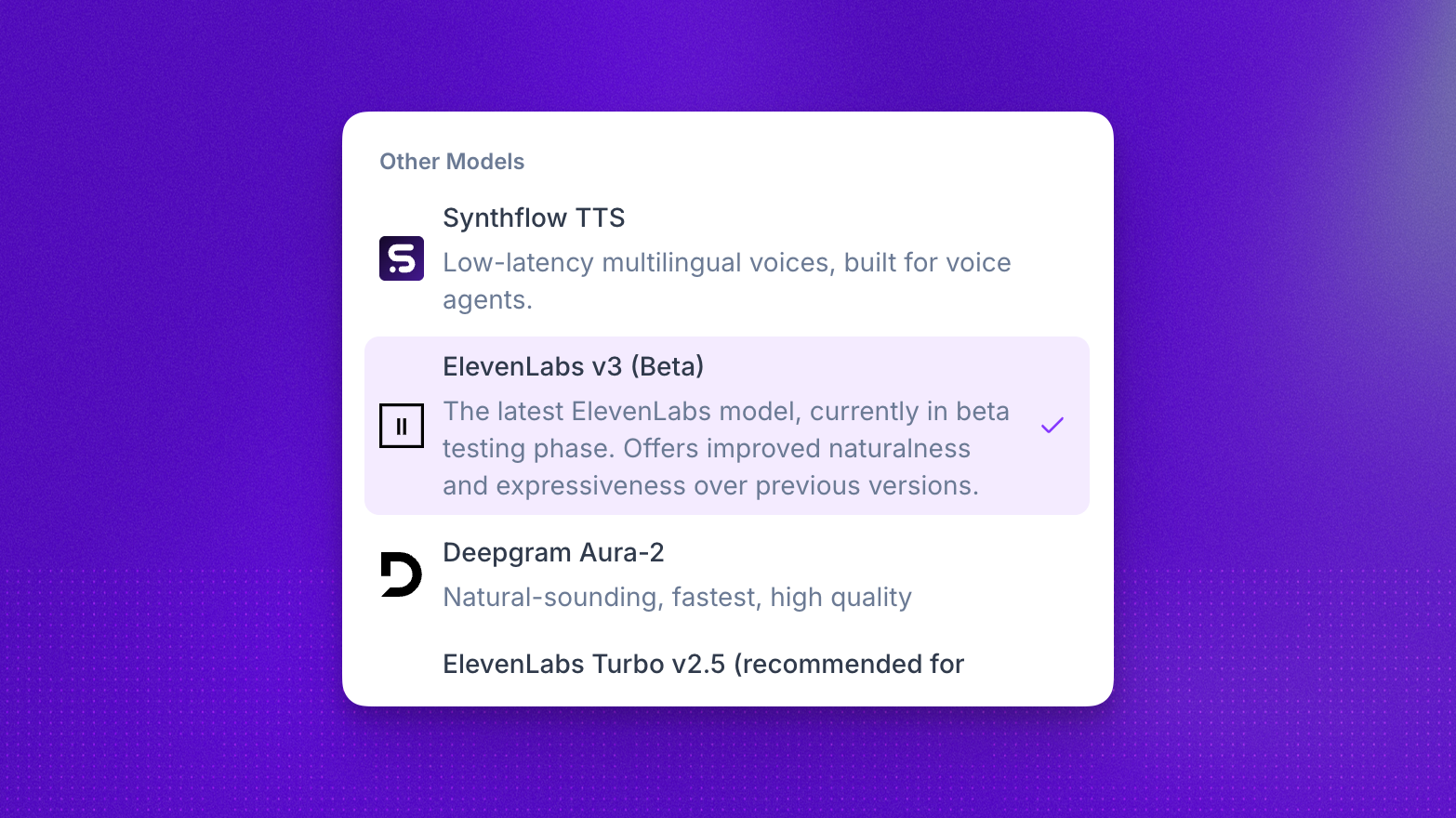
ElevenLabs V3 is now available as a voice model, bringing inline audio tag control to your agents.
Global audio tags. Set a persistent voice character for the entire call via the new Global Audio Tags field in the UI or the
global_audio_tagsAPI parameter.Situational audio tags. Drop tags inline in your prompt to shape delivery at specific moments in the conversation.
Synthflow TTS
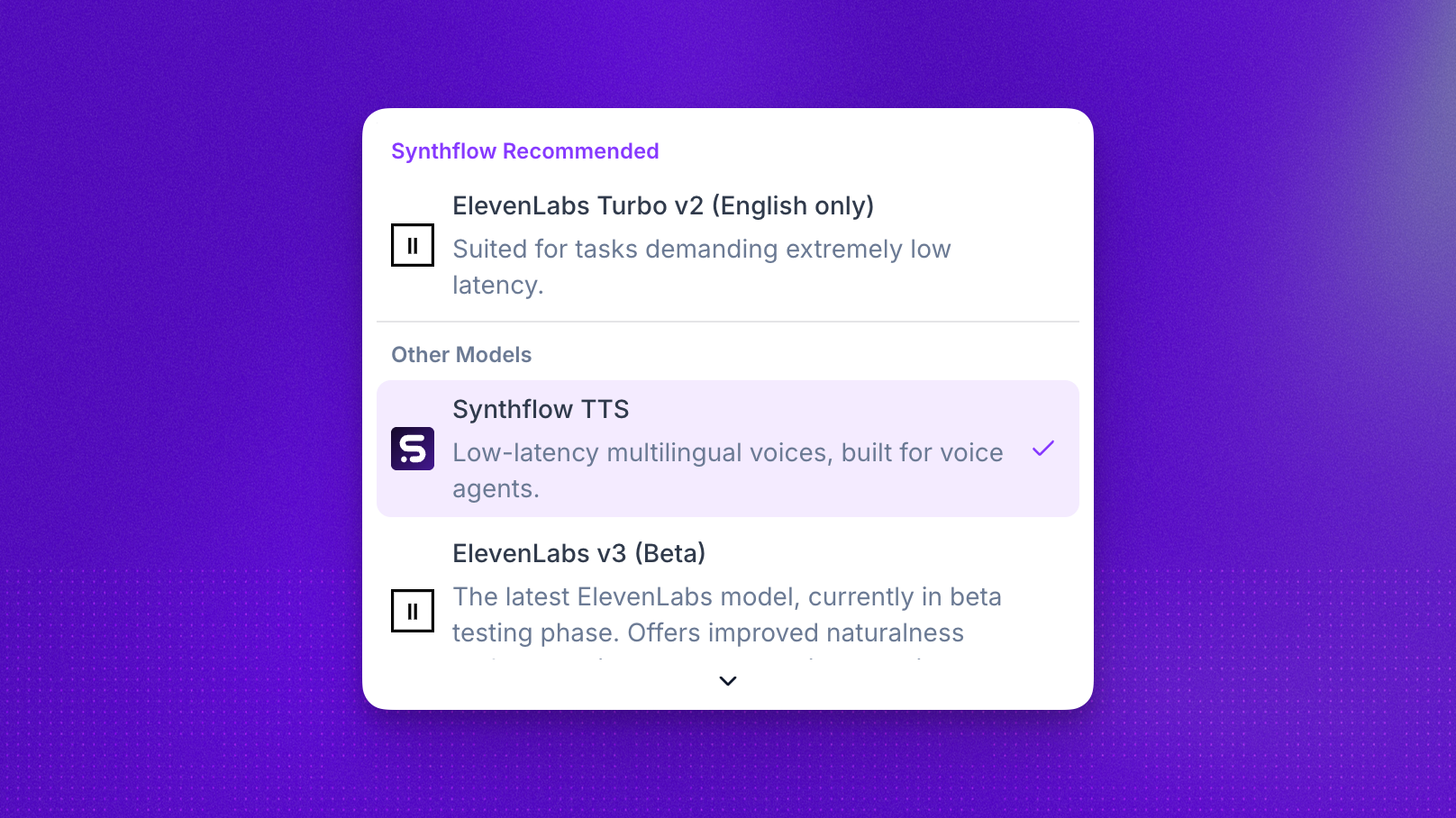
Synthflow TTS is a new in-house text-to-speech engine, designed from the ground up for real-time voice agents.
Low latency. Optimized for real-time conversational use cases with sub-200ms time-to-first-audio.
All supported languages, no voice switching. Voices keep the same timbre and quality across every language Synthflow supports. Set the language to Multilingual and pair with Synthflow STT for multilingual conversations.
12 built-in voices. Adrian, Maya, Daniel, Noah, Nina, Emma, Jack, Claire, Grace, Owen, Mina, and Kenji, each with a distinct natural character.
MCP Servers
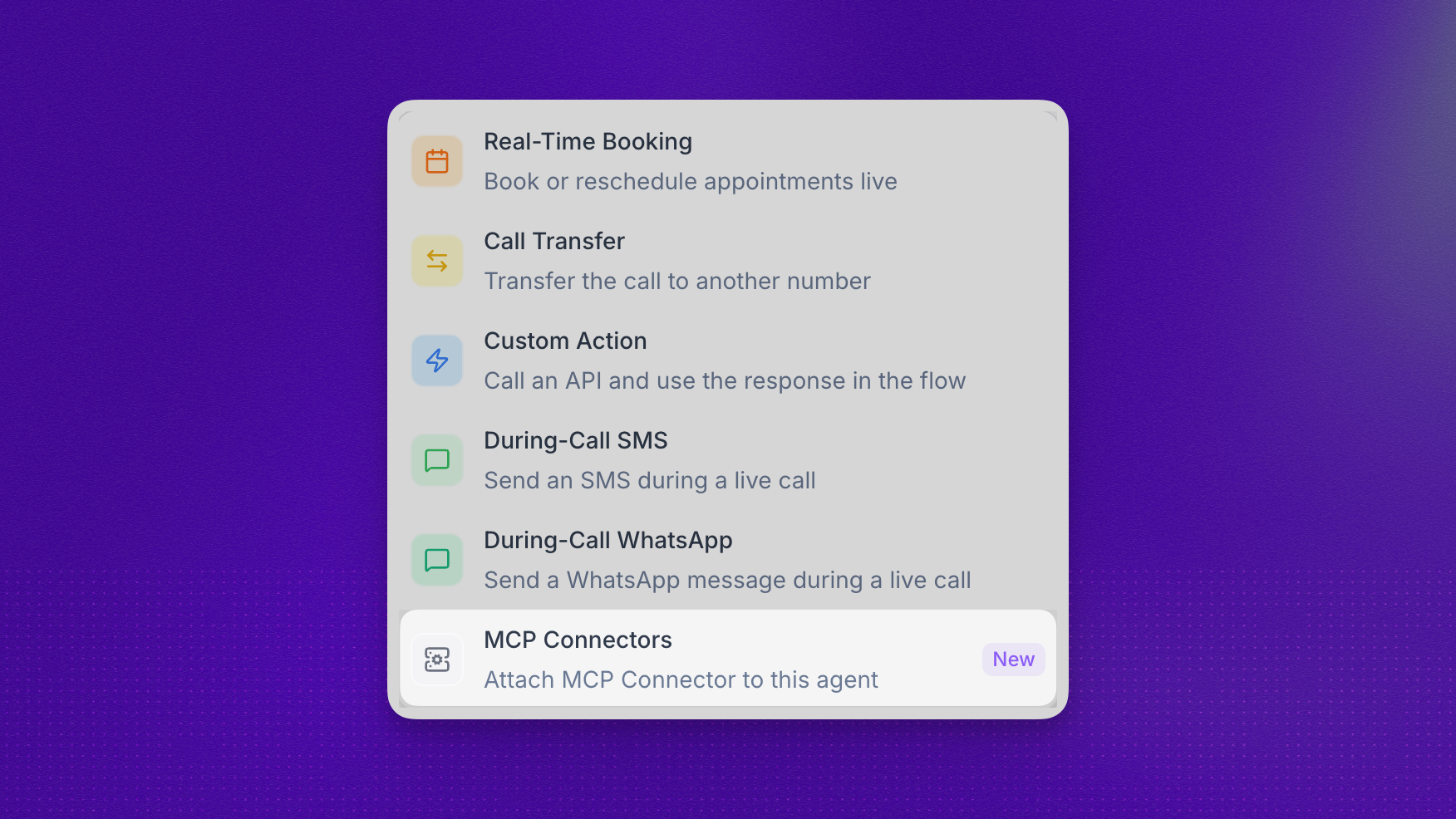
Connect your agents to external MCP (Model Context Protocol) servers and give your agent access to tools it can invoke during a call. Anything you've already exposed as an MCP server, your agent can now use without a custom action.
Connect any MCP server. Point Synthflow at the server URL and choose which tools the agent is allowed to invoke. Configure connectors from the agent editor via MCP Connectors, or programmatically through the Platform API.
Headers and query parameters. Add API keys, tenant IDs, or any other values your server expects on every request as key-value pairs when you configure the connector.
Outbound Number Pooling
Outbound number pooling lets you attach multiple phone numbers to a single outbound agent and pick the caller ID for each call. Helpful for spreading volume across numbers, matching the area code to the recipient, or rotating numbers to improve deliverability.
Attach a pool of numbers per agent. Use
PUT /v2/assistants/{model_id}/phone_numbersto attach numbers (or detach individually viaDELETE). Any number you own works: Synthflow-purchased, custom, or imported Twilio.Select the caller ID at call time.
POST /v2/callsnow accepts an optionalfrom_phone_numberfield; omit it to use the agent's default.Logs show what was actually used. Visible in UI logs and call records.
Salesforce Sandbox in Custom Actions
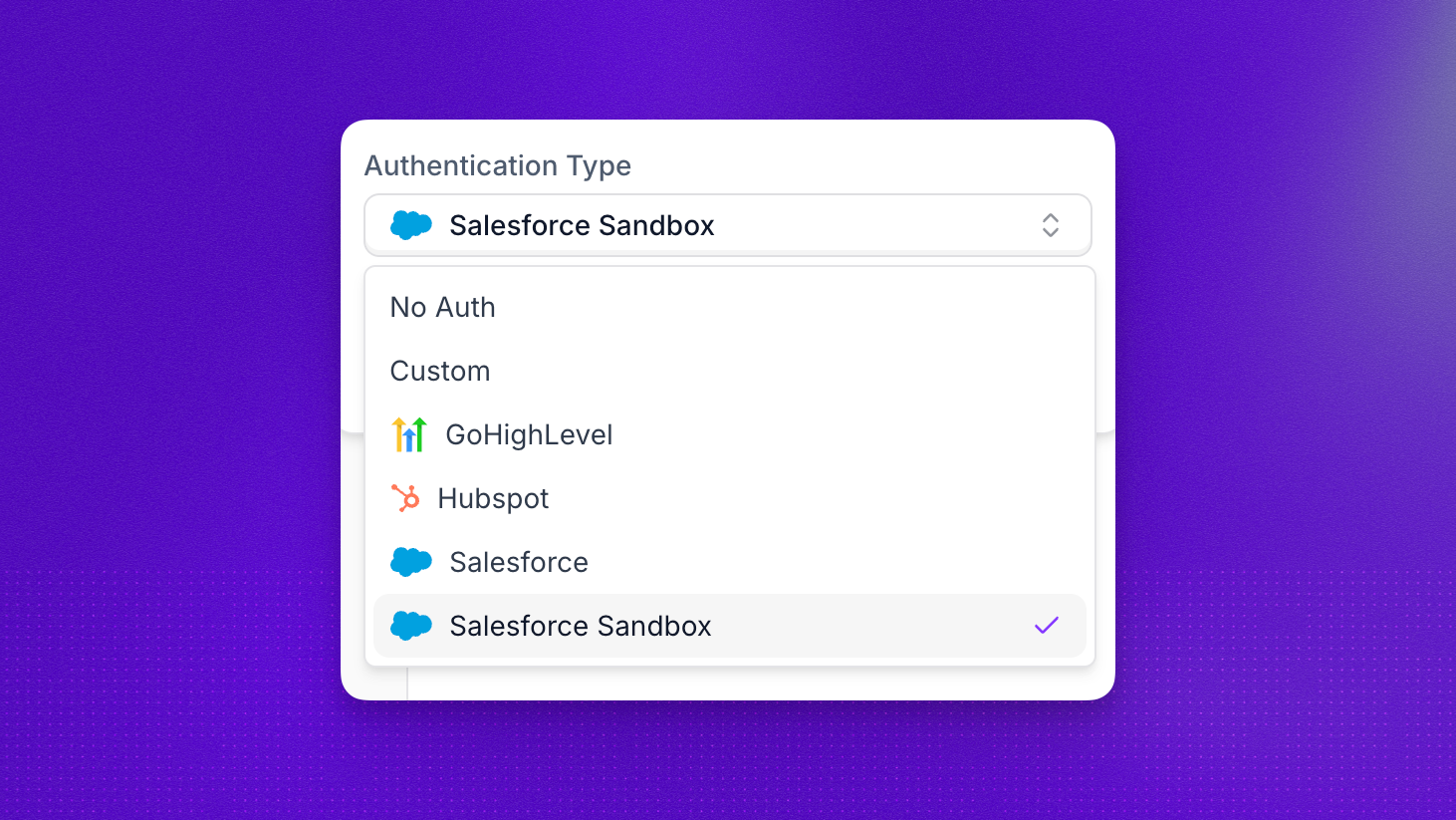
Custom actions now support Salesforce Sandbox alongside Salesforce Production. Connect both environments in the same workspace and choose the right one for each action.
Actions Improvements
Two upgrades to how actions work day-to-day:
Choose how input variables are mapped. For each input an action needs, pick how Synthflow should fill the value: collect it from the caller, use an action output, use a system variable, use a pre-call variable, or enter a fixed value.
Call history preserves deleted actions. If an action used in a call is deleted later, call details now show a deleted-action placeholder instead of removing the action entirely. Past calls stay readable even after you clean up.
Contacts is now Memory
The page formerly known as Contacts in the left-hand sidebar is now Memory, which better describes what it actually holds: the long-term knowledge your agents reuse across calls. Nothing was removed, just renamed and reorganized.
Phone books moved into Call Transfers. They now sit alongside the rest of your call-handling tools, so you configure routing in one place instead of switching sections.
Faster Navigation (Early Access)
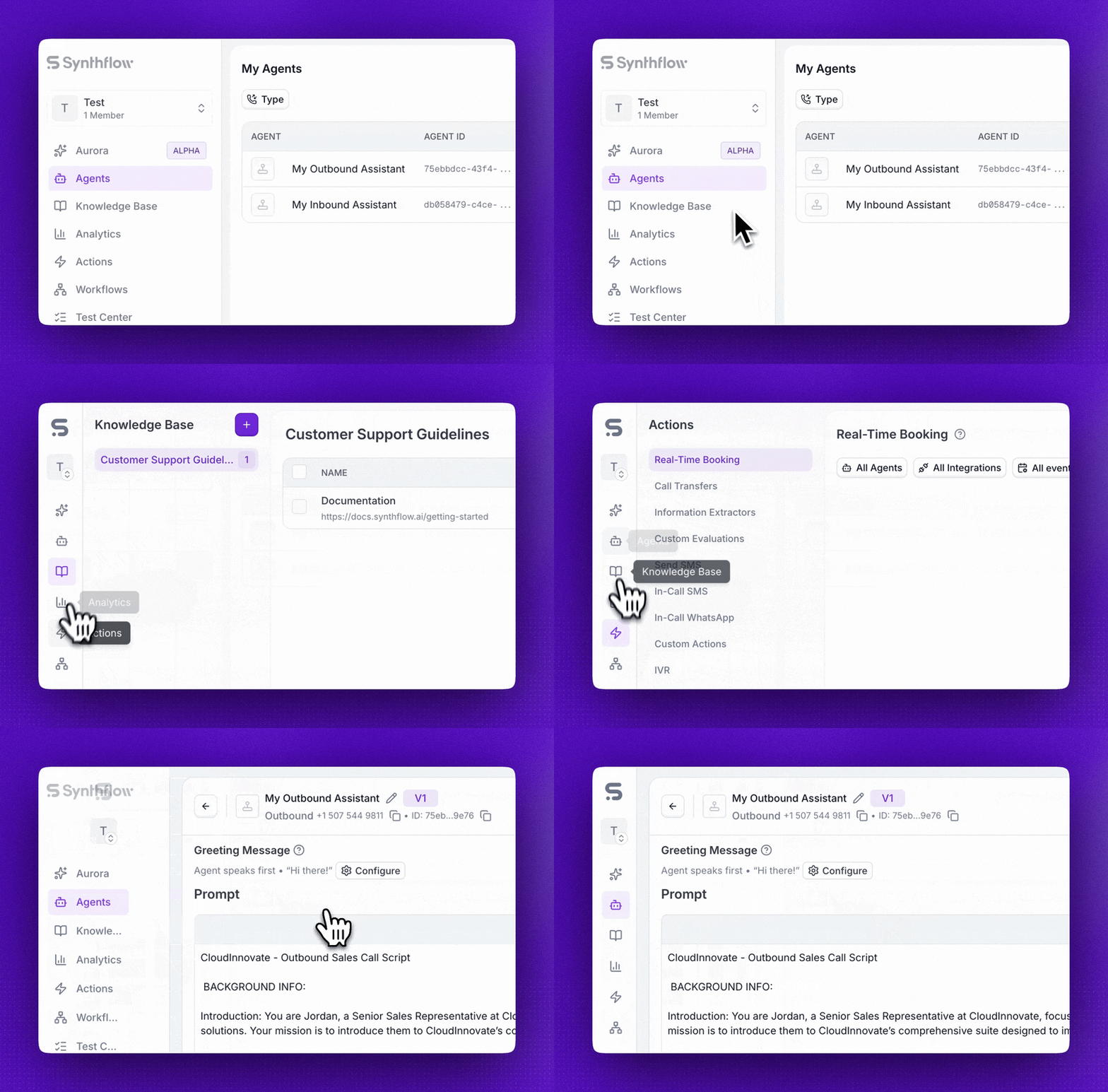
An early-access improvement that reduces the delay when switching between pages in the dashboard. App sections load more efficiently under the hood, and navigation feels noticeably more responsive.
Enable it from Early Access, and disable it any time if something looks off. Feedback during this period helps us shape it for general release.
New Languages: Catalan, Slovenian, and Welsh
Three new languages (Catalan, Slovenian, and Welsh) join the full list of languages available to speak by your agents.
API Changes
Subaccount API: explicit
grant_permissionsandrevoke_permissionsarrays replace the legacypermissionsobject on Create and Update, plus new quota fields (concurrency,max_agents,max_minutes,max_workflow_runs).Knowledge Base API: new
PUT /sources/{source_id}endpoint to update an existing source.Call Transfer API: live transfer actions accept
phone_book_idto reference an existing phone book, and a newhuman_availabilityobject to configure transfer office hours.Actions API: attach actions with per-assistant
input_variables_mapping, so one shared action can use different variable sources on different agents.Agents & Actions API: new
include_actionsandinclude_assistantsquery parameters surface relationship IDs on detail endpoints.
Bug Fixes
HubSpot Actions enrollment status. HubSpot Synthflow Actions no longer incorrectly show that an enrolled contact will remain enrolled for 6+ days.
Deprecations & Migrations
WebSocket endpoint deprecation. The raw widget.synthflow.ai/websocket/* endpoint used for direct website and app embeds is being retired. Migrate to the Synthflow Widget embed before June 15, 2026. Widget embed users are not affected.
You can track all model and API lifecycle updates on our Deprecation Notices page and subscribe via RSS or email to receive future alerts automatically.