January 27th, 2026
We’re starting 2026 strong with 100% uptime, 40% lower latency, and a new dedicated US cluster. In the Synthflow platform we are rolling out the fully Redesigned Agent Editor to all workspaces and introducing transfers to SIP endpoints.

We’re rolling out the redesigned agent editor across all workspaces. You can already opt in today via Early Access settings and the editor will be automatically enabled for all workspaces according to the timeline below.
Rollout schedule:
End of January: Rollout to Starter, Pay as You Go, Pro, and Agency workspaces this week.
First week of February: Rollout to enterprise workspaces.
With the redesigned agent editor you’ll find custom actions, agent settings, Flow Designer, and all agent settings directly in the agent view.
For workspaces that still use the legacy Flow Designer, enabling the redesigned agent editor will automatically render those agents in the new Flow Designer interface. Step nodes will appear as conversation nodes, while agent behavior and execution will remain unchanged.
Agents will continue to function as a single flexible backend prompt. However, legacy Flow Designer agents will not support some of the newer node types we’ll continue introducing.

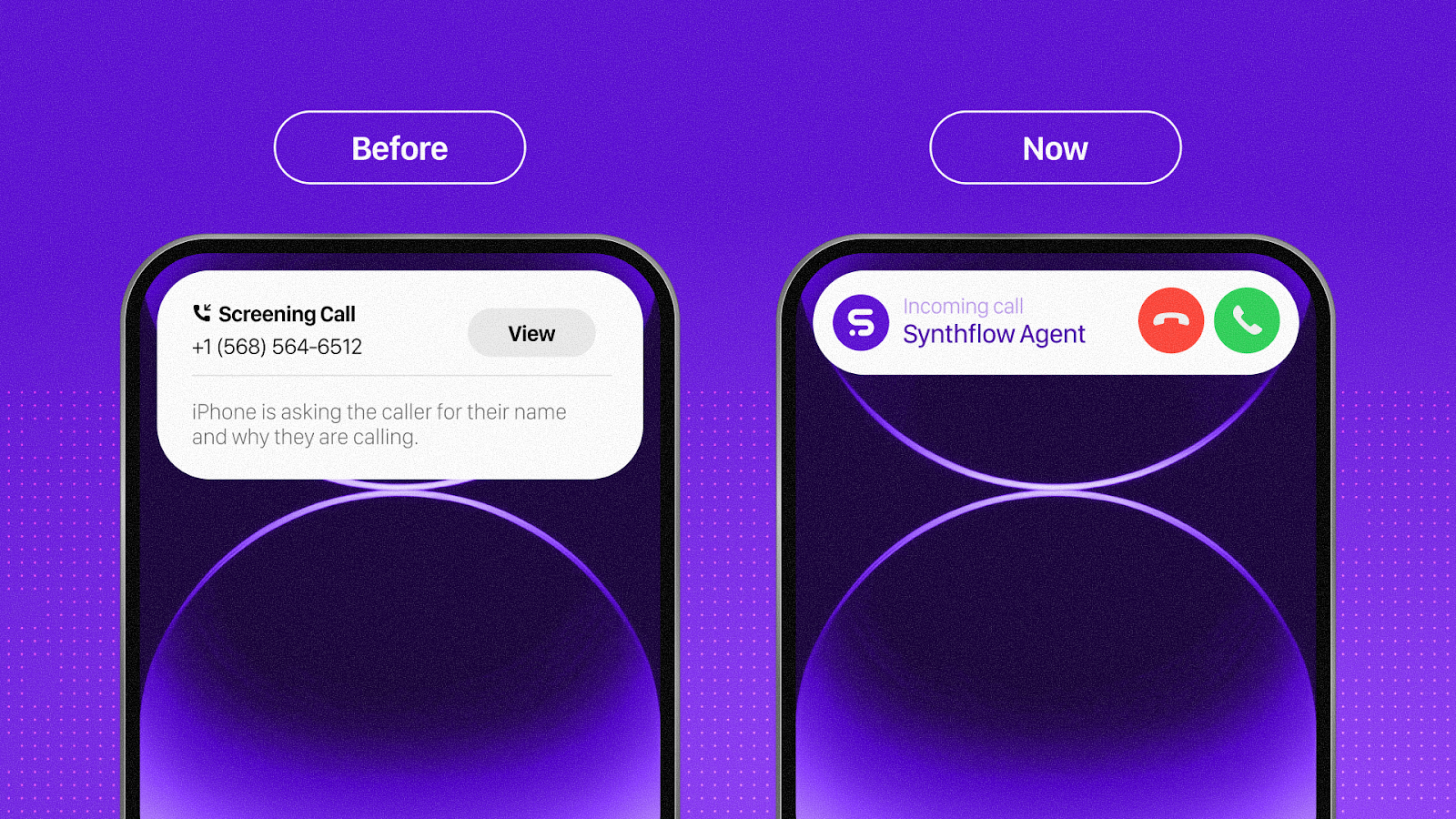
You can now transfer calls directly to SIP endpoints and pass custom metadata through SIP headers, making it easier to route calls to the right teams with the right context.
Whether you're transferring to a department-specific SIP URI or passing critical information like customer IDs or store locations from Synthflow to your human agents, SIP transfer ensures smooth handoffs between AI and human teams while preserving all the context gathered during the conversation.
Here’s what you can do:
SIP URI Support: Transfer calls to SIP URIs in addition to traditional phone numbers.
Warm and Cold Transfers: Supports both cold transfers (direct handoff) and warm transfers (call summary before handoff).
Static or Dynamic Setup: SIP endpoints and headers can be hardcoded or passed dynamically as variables.
If you’re already using SIP, you can start routing calls this way immediately and pass richer context to your human agents without changing your existing setup.

Great news for our US customers: we have launched a dedicated infrastructure cluster specifically for your region. By moving backend services and databases to US territory, we’ve eliminated cross-Atlantic latency, ensuring your workspace is faster, more stable, and fully compliant with local data residency requirements.
What this means for you:
US Data Residency & Compliance: Your data now can reside strictly within the United States. This infrastructure update helps you meet specific US data residency requirements and security standards without any extra configuration.
Significantly Reduced Latency: We’ve removed cross-continent database round-trips. Users in the US cluster will notice immediate improvements in dashboard speeds, flow publishing, and general navigation.
High-Performance Telephony: Voice requests are routed through local servers. This increases concurrent call capacity and reduces the connection time for calls initiated in the US.
Improved Stability: With localized compute resources, the system is now more responsive and resilient, even during periods of peak load.
Find out how the US cluster benefits your workspace.

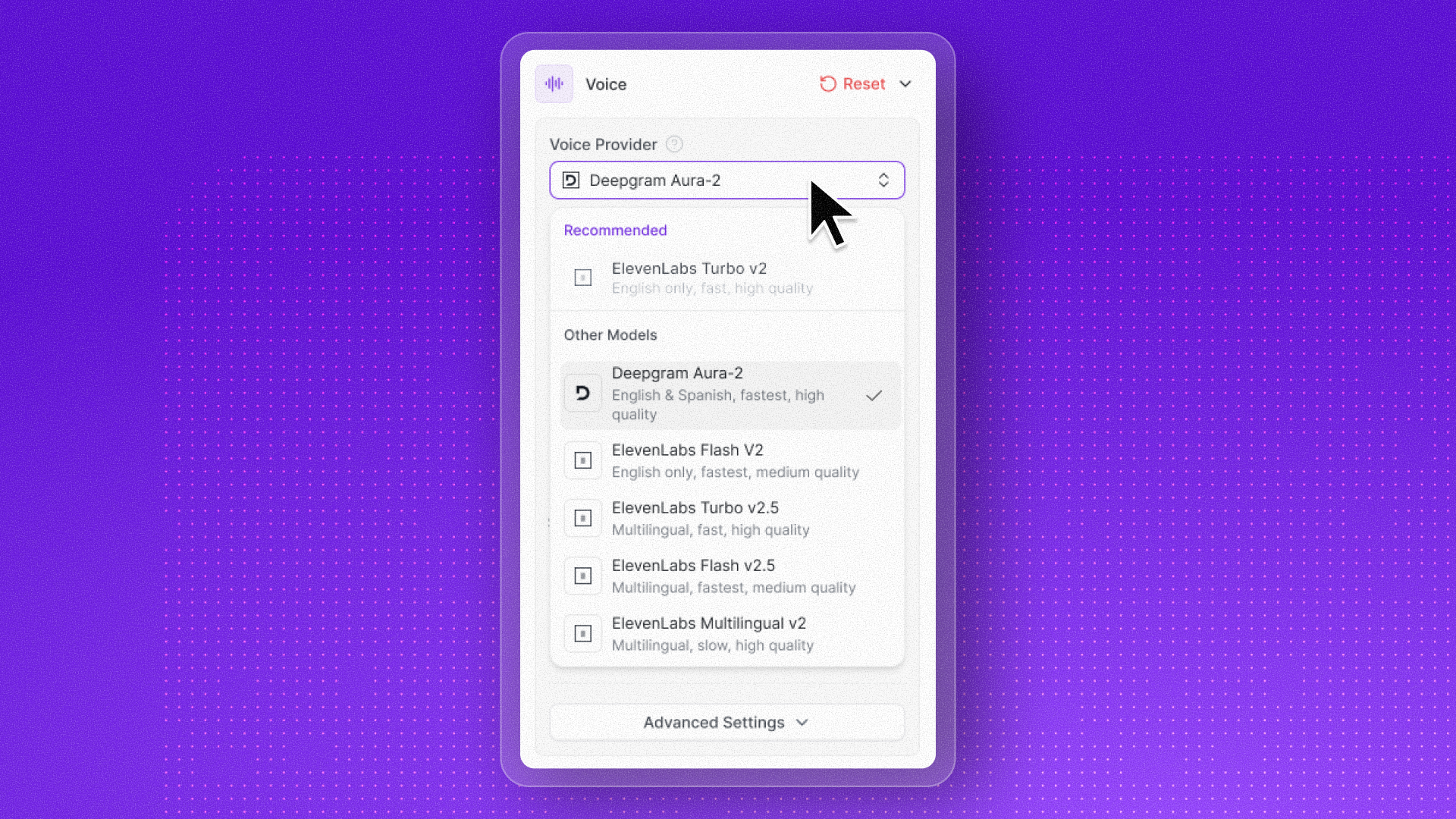
We’ve expanded our voice catalog to give you more variety and flexibility when choosing the right voice for your specific use case.
You can now explore Deepgram’s Aura-2 text-to-speech voices, adding more options in tone, style, and character so you can test what works best for your agents.
To make discovery easier as the library grows, we now default to a curated set of “Recommended” ElevenLabs voices. This helps you quickly browse a representative selection, while full access to the complete voice library remains available.
Try out the new voices to see which ones best match your agents.

Reliability remains our top priority. We have achieved 100% uptime over the past 45 days. To maintain this standard, we have upgraded our architecture to support better horizontal scaling under high load and reduced single points of failure through improved isolation.
Monitor our status and subscribe to maintenance alerts at status.synthflow.ai.

We’ve optimized our voice processing pipeline, driving a 40% reduction in average latency in January compared to December. Alongside speed, we’ve significantly improved endpointing, the logic that determines when a user is done talking.
The benefits:
40% Performance Boost: We have reduced average latency by 40% month-over-month.
Enhanced Turn-Taking: We have refined our endpointing algorithms to reduce false positives on silence detection. This ensures the agent accurately identifies the end of a user's turn, preventing agent from responding while the user is still speaking.
These improvements are already live in the Synthflow platform, so call your agent — you will feel the difference immediately.

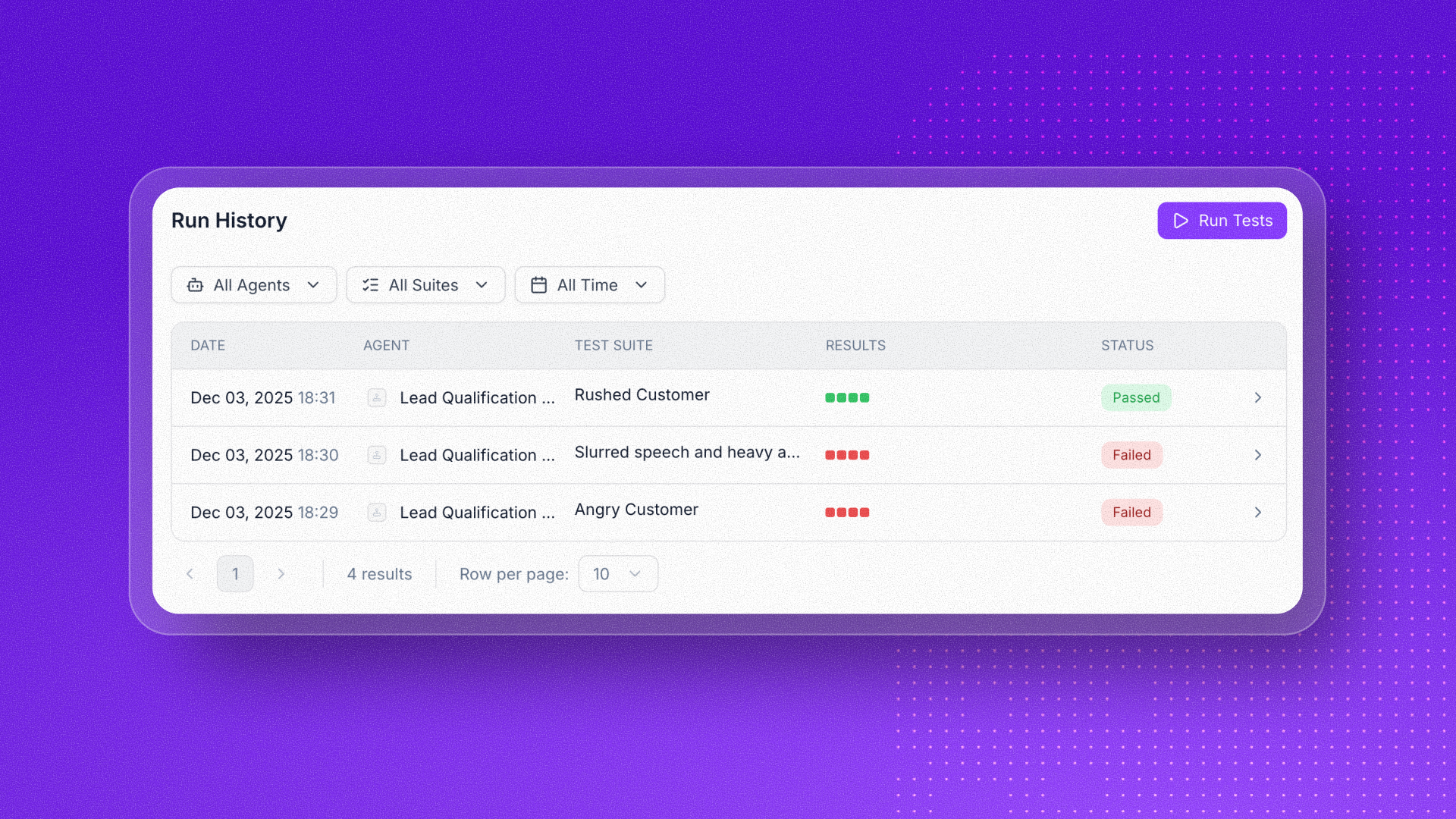
Display conversations across all agents in your workspace. This makes it easier to monitor activity, troubleshoot issues, and analyze performance across your entire agent fleet from a single view. Learn more.
In case you missed our December releases, we shipped Agent Versioning for easy agent management and rollbacks rollbacks, Custom Actions v2 with system variables and auto-detection, Synthflow STT for improved non-English language support, GPT-5.2 integration, and major phone number management improvements.
December 30th, 2025
This is our final changelog of 2025, and we’re focused on making teams faster today, and setting you up to ship with more control heading into 2026.
The headline of this release is the new Agent Editor v2: a redesigned agent workspace that puts every setting, action, and flow decision in one place.
Right behind it is a major improvement to call quality with Synthflow STT, a multilingual transcription upgrade that makes non-English calls (especially German and Spanish) far more accurate.
And because faster building only matters if shipping stays safe, we’re also launching Agent Versioning, plus GPT-5.2 availability and phone number + routing reliability improvements.
Keep scrolling for the full breakdown!
P.S. Thanks for building with us this year, and happy new year from all of us at Synthflow.

Agent Editor v2 is a comprehensive redesign of the Synthflow platform that brings all agent settings directly into the agent view. With Agent Editor v2, settings that used to be spread across the platform are now accessible directly inside the agent view, making iteration noticeably faster.
You’ll find a redesigned experience across custom actions, agent settings, flow designer, and more, all in a more compact, modern, enterprise-ready interface. It works seamlessly for both single-prompt and flow designer agents.
Agent Editor v2 is available via a self-serve preview switcher, so you can toggle between UI versions and test it before fully committing.
No more bouncing between pages. Everything you need to build, tune, and manage your agents now lives in one place.
Agent Versioning gives you complete control over how your agent changes over time. Every time you publish, Synthflow creates a new version, so you can move fast without losing track of what changed.
With Agent Versioning you can:
Create and manage versions: Publish changes to generate a new version with a clear diff showing exactly what changed across prompts, settings, and flow designer nodes.
Export versions as JSON: Back up agent configurations to GitHub or your own storage for safekeeping and auditability.
Restore previous versions: Roll back to any prior version when needed—ideal for testing, troubleshooting, or reversing an unwanted change.
Track version history: View the complete timeline of edits with version numbers visible throughout the platform.

More powerful, easier to configure, and significantly faster to ship.
Custom Actions have been redesigned inside the new Agent Editor v2 to make integrations quicker, cleaner, and harder to mess up. The new system is fully backwards compatible, while introducing major workflow improvements.
Key upgrades include:
System Variables: Instantly access call data (like call_id, user_phone_number, from_phone_number, and more) by typing < in any URL, header, or body field—no extra configuration required.
Auto-Detection: Input variables are automatically detected from your JSON using <variable_name> syntax, with intelligent autocomplete and auto-save when mapping.
Smoother Workflow: Configure actions faster in Agent Editor v2, use before-call action data anywhere in your flow, and map variables with far less manual effort.

We’ve deployed a new speech-to-text model, Synthflow STT, to solve a critical pain point: reliably capturing phone numbers, names, and invoice/reference numbers in German, Spanish, and other non-English languages.
Internal testing shows this model performs markedly better than our previous provider—especially on the kinds of high-stakes details that make or break real deployments.
If you have customers running German or Spanish agents, we strongly recommend testing (and switching to) Synthflow STT. It’s a game-changer for accuracy.
GPT-5.2 is now available in the Synthflow platform.
A quick note from our testing: GPT-5.2 can be more verbose than teams expect. Before switching a production agent, use the Test Center to validate behavior and confirm your agent remains backwards compatible.
If you want to be extra safe, run Simulations to compare model behavior across the same real caller scenarios before you roll anything out.
Phone number management has been significantly upgraded across performance and API capabilities for faster operations, better reliability, and improved error handling.
Attach/detach phone numbers: Much faster operations with reduced latency.
List phone numbers: Significantly improved endpoint performance.
Import custom numbers (Enterprise only): Faster imports with clearer error messaging.
A set of additional improvements shipped this week:
Improved voicemail detection: Fixed the edge cases where the audio from the user was not being captured and this was causing the system to misclassify some voicemail samples.
Concurrency adjustments: With improved concurrency management, agents can now answer calls even faster.
Telephony infrastructure: New edge/router setup for more reliable, efficient call routing—plus improved call tracking and external ID traceability.
December 4th, 2025
This month marks an exciting milestone for Synthflow. We’re introducing Synthflow Chat, expanding our platform beyond voice so your agents can now handle written conversations with the same intelligence, logic, and infrastructure you rely on for calls.
This release also brings major upgrades for enterprise teams, including Simulations 2.0 for automated regression testing, Multi-Agent Systems that are now more powerful with reusable subflows, full GPT‑5.1 support, and enhanced platform controls designed for large-scale deployments.
And this is just the beginning. Over the coming months, we’ll continue expanding how and where your agents can operate, moving toward a fully unified, omnichannel experience.
Some customers call. Others prefer chat. Stop managing separate agents for separate channels. Synthflow Chat unifies your customer experience.
Your agents now handle written conversations with the same intelligence as voice, booking appointments, updating your CRM, and solving problems instantly.
Build agents once with our visual flow designer and use them across voice and chat. Deploy in minutes by embedding our widget or integrating on your terms via the API.
Unified Agent Model: Use your existing voice agents for chat. No need to maintain separate agents.
Embeddable Widget: Add a chat widget to your site with a simple code snippet.
API Chat Sessions: Programmatically manage chat interactions for custom integrations.
Unified Logging: Review chat transcripts alongside call logs in a single dashboard.

We’ve made building modular, scalable agents even easier. Subflows act as specialized, reusable agents that can be activated by specific intents (e.g., "Caller mentions severe symptoms"), allowing you to organize your conversation graph efficiently.
With the new Return to Main Flow node, you have explicit control over when a subflow hands control back. Once the subflow completes its task, control returns seamlessly to the main agent exactly where it left off.
Scalable Logic: Break complex agents into manageable, reusable components.
Seamless Hand-offs: Delegate specific tasks to subflows and return to the main conversation flow automatically.
Read the Multi Agent Systems documentation

Testing Voice Agents is notoriously difficult. That’s why in Simulations 2.0, we are introducing test suites—making it easy to group related test cases and run them in batches. Simulations are now dramatically faster and more cost-effective to run, enabling you to automate regression testing for Voice AI.
Instead of manually calling your agent to check for issues after every change, you can now use automated test suites to verify that your agent still performs exactly as expected.
Test Suites: Group related test cases and run them together, with improved speed and lower cost.
Auto-Generated Tests: Automatically generate comprehensive test cases based on your agent's prompts.
Detailed Analysis: Get pass/fail breakdowns based on specific success criteria.
Read the Test Center documentation

We are committed to making the latest models available within days of release. Ever since it was released you can use GPT-5.1, the most advanced model from OpenAI, to drive your agents.
GPT-5.1 brings unprecedented conversational intelligence to voice AI. To ensure you get the most out of the model, our prompting guide provides essential strategies for crafting optimal interactions.
Read the GPT 5.1 Prompting Guide
We have strengthened our voice infrastructure to ensure your agents are always ready to speak. We now support multiple high-quality voice providers with automatic failover.
If your chosen voice experiences an outage, our system will instantly switch to a perceptually similar voice from a backup provider. The transition is seamless, and the person on the other side of the line won't even notice, ensuring your operations continue without interruption.
For our enterprise partners, the X-EI SIP header allows you to pass critical metadata—such as internal Call IDs, CRM records, or diversion history—directly through SIP headers. This ensures downstream systems and Synthflow logs stay perfectly synced.
Admins can now directly access and review logs within subaccounts for faster troubleshooting.
We have increased the maximum call duration to 100 minutes, supporting longer consultations, complex support triage, and extended interview sessions.
October 23rd, 2025
We’re wrapping up the week with a new release, and it’s packed with improvements inspired by how teams like yours use Synthflow every day.
Build Multi-Agent Systems starting with Subflows, which make every part of your flow modular, reusable, and powered by specialized agents.
The new Logs are your one dashboard where you can see all calls from your agent workforce. Inspect call recordings, API calls, and webhooks in one view, making it easier than ever to trace, debug, and stay on top of what’s happening in real time.
Find out more below.

Subflows are a fundamental component of the Multi-Agent System, helping you organize and modularize your conversation graph. Each subflow acts as a specialized, reusable agent that can be activated by a specific intent or event.
For example, you can define a trigger such as “The caller mentions severe symptoms.” Whenever this intent is detected, the main agent delegates that part of the conversation to a subflow designed to handle this scenario. Once the subflow completes its task, control returns seamlessly to the main agent at the point where it left off.
By structuring logic this way, the Multi-Agent System remains scalable and maintainable. Subflows enable better collaboration between agents, simplify complex interactions, and promote reusability across different conversational contexts.

Advanced Flow Designer now allows branching transitions based on natural language conditions in addition to logical conditions. The agent can now evaluate natural language conditions before moving nodes, enabling more nuanced, context-sensitive branching based on conversation content and user sentiment. This makes the agent more flexible and intelligent.

Flow Designer now supports enum variable types, allowing you to create dropdown-style variables with predefined options. This ensures users can only select from valid choices, improving data quality and reducing input errors in your conversation flows.

Within the Speak node, you can now ensure messages are delivered exactly as written, bypassing AI generation for compliance-critical or sensitive communications. Approach with confidence scenarios where regulatory or safety requirements demand precise phrasing. For example, when a caller mentions severe symptoms and the Agent must not triage but instead redirect the caller to emergency services using a compliance-approved message.

Synthflow now provides a unified logging system that gives you complete visibility into all your voice agent operations. Access detailed logs for calls, API requests, and webhook interactions from one centralized view.
See full call transcripts and metadata, audit every API request with request/response details, and monitor all webhook deliveries with real-time outcomes and retry tracking. Powerful filtering, search, CSV export, and detailed drawer views make it easy to debug agents and analyze performance.
Agents can now transfer live calls to SIP destinations (PBX systems, SIP phones, softphones). This enables outbound-to-internal handoffs and real-world escalation workflows like SDRs warm-transferring prospects to AEs, support agents escalating to specialists, operators routing calls to departments, or healthcare and legal teams handing off callbacks to internal providers.
Multi-region RTP engine support for Latin America, providing improved call quality and reduced latency for users in Latin American markets through localized RTP infrastructure.
We added more filters and improved get list calls public API, providing enhanced filtering capabilities and better performance for retrieving call data through our public API endpoints.
Send call ID and model ID with action API for better tracking, providing enhanced traceability and debugging capabilities for custom actions by including call and model context information.
Switched to state-of-the-art Nova3 model for German and Spanish languages to provide natural, accurate, state of the art speech transcription. Nova3 will be used by default for German and Spanish language.
Enterprise customers can now enable Salesforce for their subaccounts. This allows subaccounts to connect their own Salesforce accounts and create custom actions directly within the platform — giving each team more flexibility and control over their CRM workflows.
September 25th, 2025
We're delivering on your biggest requests, including an advanced flow designer that ends AI unpredictability and a brand new test center that allows you ship perfect agents every time. And for the first time ever, we're bringing Synthflow Voice AI Agents to Whatsapp, with super easy integration and 24/7 inbound call coverage in the world's most popular messaging app.
Catch all the latest details in the changelog below. And as always, stay tuned for more great features coming soon!

When you're handling millions of business critical calls, hoping for the best isn't a strategy. That’s why we’ve created the Advanced Flow Designer. The Advanced Flow Designer offers several improvements over the original version:
Reliable conversation flow: Conversations now move through each node in a predictable, step-by-step sequence. This makes outcomes more reliable and easier to debug.
Variable collection: Collect and store variables directly from users during calls, enabling more dynamic and personalized interactions.
Branching logic: Define concrete rules—for example, if the user asks for Sales, route them to the Sales flow.
When creating a new agent, you can choose between the Original Flow Designer and the Advanced Flow Designer.
Use the Original Flow Designer if you want a balance of flexibility and structure.
Use the Advanced Flow Designer if you need strict, deterministic business logic.
Note: The Advanced Flow Designer is currently in beta, and we’re rapidly adding new features.

Transfer calls dynamically based on conversation context, inputs, or business logic. No manual steps required.
Context Aware Routing: Use conversation variables and conditional logic to send calls exactly where they need to go.
Seamless Context Handoffs: Preserve the full conversation thread when transferring to human agents or external systems.
First Call Resolution: Get customers to the right expert on the first try.
Transform every transfer into the right transfer.
Your Voice Agents now work directly in WhatsApp, the world's most popular messaging platform. Connect with customers on their preferred channel without rebuilding your conversation logic.
Zero Friction Access: Customers make calls directly in WhatsApp.
Unified Experience: Your existing prompts, routing logic, and integrations work seamlessly across channels.
Enterprise Ready: Built with compliance and scale in mind, so you can roll out globally with confidence.
Transform how customers connect with your business. Start reaching them where they already spend their time.

Stop crossing your fingers when you deploy. Simulate complete phone conversations with your Synthflow AI Agent in the Test Center, validating changes before they reach production.
Comprehensive Testing: Measure accuracy, prompt adherence, custom actions results, and regression test prompts and flows automatically.
AI Generated Test Suites: Auto generate test cases from your agent's prompt and actions, then customize scenarios and success criteria as needed.
Success Criteria Validation: Test for Customer Satisfaction (CSAT), Accuracy of Responses (Hallucinations), Repetitive Phrases & Fillers, Conversational Naturalness, and Task Completion automatically.
Prevent breaking changes from reaching production. Hit play, catch problems, and ship agents that work perfectly from day one.

Control consent for recording and transcription across your assistants from the Configure tab or via API. Your agent will request consent and automatically start recording only when permission is granted.
Set and Forget Configuration: Enable consent requirements across all agents from a single settings panel or via API.
Personalized Messaging: Customize exactly what your agent says when requesting recording permission.
Developer Friendly: Full API support with consent_recording and consent_text parameters in all agent endpoints.
Deploy compliant recording practices in minutes, not months.

Send invitation links that only work for the intended recipient, with automatic workspace access when they sign up.
Foolproof Security: Invitation links are bound to specific email addresses, preventing unauthorized access.
Zero Admin Overhead: Matching email addresses automatically grant workspace access without manual approval.
Clear User Experience: Mismatched emails get helpful guidance to request new invitations.
Secure your workspace without slowing down your team.

We now support multiple Admins. The Super Admin retains full org control and is the primary workspace contact, while Admins (now multiple) can manage users and roles (except Super Admin), billing, and API keys. Members remain unchanged with access to core features only.
We've hardened the foundation so your agents keep working even when the unexpected happens.
Automatic TTS Fallback: If ElevenLabs experiences issues, calls seamlessly switch to backup voice providers. Conversations continue without dropping, though you might notice slight voice changes in rare cases. Learn more
100% Uptime: Synthflow delivered uninterrupted reliability in August and September and implemented a 0-bugs policy.
Support for External Call Identifiers: Instead of relying only on Synthflow’s internal call ID, you can include your own call ID (E.external_id) and preserve it across every transferred leg of a call. This makes it easier to match Synthflow activity with your PBX or CRM logs.
This is just the beginning. Quality, reliability, and scale remain our highest priorities. Thank you for the feedback that drives us to build what matters most.
August 7th, 2025
Your agents now remember caller details, transfer calls based location and advanced conditions, reliably follow call flows, and filter out background voices for clearer conversations.
And now… GPT-5 is live in Synthflow!
Plus, you get new voice speed and volume controls, a GDPR toggle, and a direct Salesforce Service Cloud integration.

OpenAI’s most advanced model yet is now available for your Synthflow Voice AI Agents. GPT-5 delivers stronger reasoning, richer context handling, and improved accuracy. What this means for you:
Better reasoning: Handles more complex conversation paths with higher accuracy.
Enterprise-ready: Built on our compliance foundation, with EU data residency in progress.
Custom Evaluations: Measure GPT-5’s performance on real calls and adapt quickly.
Use GPT-5 inside Synthflow today to combine the latest model advances with the infrastructure that makes them production-ready. Try it on your own use-cases!

Now your Voice Agents never forget a conversation. With Memory, your Voice Agents deliver personalized experiences across multiple conversations, so callers never have to repeat themselves.
Continuous Context: Agents maintain conversation state across sessions, reducing caller frustration and improving customer satisfaction.
User Metadata: Store and recall details for truly tailored interactions, making every call smarter and more efficient.
Team Collaboration: With Memory Groups share memory states across your Voice Agents.
Turn on Memory today and let your Voice Agent build relationships with your users.

Enterprise users can now connect directly to Salesforce Service Cloud with OAuth for seamless ticket creation, updates, and CRM integration.
Automated Ticket Handling: Instantly create and update Cases, Leads, Contacts, and Opportunities in Salesforce during live calls.
Enterprise-Grade Security: OAuth-based authentication ensures secure, compliant access for your team.
Flexible CRM Support: Designed for Salesforce Service Cloud, with integrations on request with other platforms using OAuth including Zoho, Zendesk, and Intercom.
To enable, connect your account to Salesforce and then deploy via a Custom Action.

Your Voice Agents now sound even more natural and responsive. With new parameters for speed, volume, and interruption sensitivity you can fine-tune every call to fit your need.
Voice Speed: Adjust how fast your agent speaks to match your audience and use case.
Volume Control: Set the perfect loudness for accessibility and clarity, ensuring every caller feels heard.
Interruption Sensitivity: Decide how easily your agent yields to human input, for conversations that feel truly human.
Try these new settings to create voice experiences that are as unique as your business. Available now via API and coming soon to the UI.

Route calls dynamically based on user input, business hours, or custom logic. Replace dozens of manual transfer actions with a single, centralized phonebook.
Bulk Management: Add, label, and organize up to 50 numbers per phonebook in the UI, with unlimited expansion via API.
Conditional Routing: Route calls based on caller input, business hours, or custom logic.
Easy Assignment: Attach phonebooks to agents instantly, so your team can scale without complexity.
Phonebook makes it easy for your Voice Agents to connect callers to the right location, no matter how many sites or departments you manage.

Our new Voice Isolation technology can now distinguish between the actual speaker and background voices, like TV or other people talking.
True Speaker Recognition: Distinguishes the actual caller from background voices, eliminating confusion from TVs or other conversations in busy environments.
Customizable Isolation Levels: Fine-tune how aggressively the agent filters out background voices, with settings from "basic" to "extreme" to fit your needs.
Complete Upgrade, No Compromise: Includes all previous noise cancellation capabilities, with no performance loss. This is a full improvement, not a replacement.
To get started, simply enable Voice Isolation in your agent settings.

We’ve reimagined Flow Designer by upgrading with our new Structured Dialogue Engine (SDE) in the backend. A foundational upgrade that solves the single biggest flaw of LLMs: unpredictability at scale. With SDE, building, launching, and maintaining advanced Voice AI Agents is no longer a fragile experiment: it’s a repeatable, dependable process.
Why? Because when you’re handling millions of business-critical calls, “winging it” doesn’t work.
What the Structured Dialogue Engine Brings:
Reliability at Scale: By separating logic from language, SDE virtually eliminates hallucinations and rogue transitions.
Maintainability: Modular flows let you adjust business logic without retraining models or rewriting prompts.
Speed to Scale: Plug in new flows or integrations in minutes — no fragile mega-prompts to untangle.
Trustworthy UX: Goal-oriented, structured dialogues drive user satisfaction and consistency.
Compliance, Built In: Clear, auditable state-based flows make it easy to meet industry regulations.
Experience the next generation of conversation design and see how easy it is to launch agents that sound human and act with confidence.

Your have complete control over Voice Agent creation, updates, and configuration through our expanded public API.
Agent Endpoints Fully Updated: All assistants endpoints got updated. You can now Get, Create, and Update all agent parameters.
Fine-Grained Parameter Control: Parameters include allowed_idle_time_seconds (disconnect after idle period), background_noise (add natural ambient sounds), consent_message (custom recording consent). Control voice configuration, agent behavior, and call experience with 29 additional parameters.
Language-Aware Synthesizer: Automatic voice synthesizer updates when changing language settings ensure your agents maintain optimal performance.
With full control over voice, behavior, and environment, this API update empowers you to craft agents as dynamic as your use case.
Stay ahead with continuous improvements and new integrations designed to enhance your Voice AI operations.
OpenAI Scale Tier for Enterprise: Enterprise customers now benefit by default from the OpenAI scale tier for enhanced performance and reliability. Learn more
GDPR Data Retention Controls: Users can now enable a 30-day data retention limit, automatically deleting transcripts, caller IDs, and recordings for compliance.
Enhanced Call Debugging: The get call API now returns additional fields to help users troubleshoot and optimize call performance.
July 23rd, 2025
Hey!
Summer’s heating up and so are our updates!
We’ve launched two of your most-requested features for monitoring agents. Verify the outcome of your calls with Custom Evaluations that score calls on your own definition of success. Next, keep an eye on it all with the Analytics Dashboard’s real-time charts. If a metric slips, you’ll see it faster than your users will feel it.
And when you’re ready to take those rock-solid agents out into the world, the rest of this release has your back. The new WebSocket SDK drops Synthflow straight into any webpage or app, our Advanced Batch templates turn massive outbound lists into a few clicks, and 17 new languages allow you to greet customers in their own words.

The new dashboard gives you a single place to monitor Voice AI agents in production.
Key highlights:
Monitoring: Monitor call volume, call status, and success rate
Reporting: Create reports without manual exports
Quality assurance: Find and address quality issues with live metrics
No setup required. All key metrics are in one place, optimized for speed and clarity.
Documentation: Read here →
API Documentation: Read here →

Synthflow now supports 17 additional languages including Bulgarian, Czech, Finnish, Greek, Hungarian, Indonesian, Japanese, Korean, Malay, Norwegian, Portuguese, Romanian, Russian, Slovak, Spanish, Turkish, Ukrainian, and Vietnamese.

We’ve rolled out Custom Evaluations, a powerful After the Call action you can now attach to any voice agent. Simply type natural-language checks like “Did the agent explain the loyalty program?”, and our LLM automatically reviews each transcript, returns a verdict, and highlights the exact sentence(s) that justified the decision.
Key highlights:
Instant visibility: Verdicts appear seconds after the conversation ends
Performance surfacing: Quickly identify your highest-performing agents and drill into failed calls for QA and coaching
Business alignment: Evaluate agents against your real-world goals, not generic scripts, using free-form criteria tailored to your operation
Use Custom Evaluations to enforce brand standards, process adherence, or any outcome you care about.
Documentation: Read here →
API Documentation: Read here →

The new workflow templates make outbound calling a breeze. With workflow template Advanced Batch I automate outbound calls from a Google Sheet contact list. Perfect for bulk sales, marketing, or customer engagement.
How to set up Advanced Batch I:
Go to Workflows → Create Flow → Use Presets and select “Advanced Batch 1.”
Download the Google Sheet template.
Fill in your contact list.
Set up a webhook to trigger the workflow (manual start isn’t supported).
Adjust business hours as needed (default is Eastern Time).
Trigger and test your workflow.
With Advanced Batch II automate follow-up sequences to efficiently nurture leads.
Video Tutorial: Watch here
Google Sheet Template: Access here
Synthflow is now seamlessly integrated within the Freshworks ecosystem. Freshworks users can now effortlessly deploy Synthflow Voice AI agents directly within Freshcaller, enabling automated and intelligent customer interactions 24/7. Securely and reliably integrate enterprise-grade conversational AI.
Install now: Freshworks Marketplace

Synthflow Phone Book (coming soon) simplifies and scales conditional call transfers, so your AI agents can route callers to the right branch or department automatically, without complex setup. Unlike rigid transfer trees, Phone Book will centralize routing logic into a single, manageable interface, supporting over 50 numbers in-app and unlimited via API.
Key Capabilities:
Conditional Call Routing: Route calls dynamically based on user input (e.g. ZIP code, department request, time zones)
Advanced Conditions: Connect callers to the nearest store, office, or hospital with the lowest queue time or any other custom condition
One Action, Not 50: Replace dozens of manual transfer actions with a single, centralized phone book.
After a transfer, Synthflow will no longer record the conversation between the customer and the transfer target. This change applies to all existing transfers. To continue recording post-transfer, use the update action API and set the payload: "stop_recording_after_transfer": false
Websocket SDK: Embed Synthflow Voice AI agents directly into any website or app without altering your existing configurations, prompts, integrations, actions, or workflows. Seamlessly combine web-based and phone-based campaigns (Documentation →)
Warm Transfer API Enhancements: Create and update warm transfer actions via API
Post-Transfer Billing Update: Minutes after call transfer are no longer billed
OpenAI Priority Processing: Reduced latency for Enterprise customers
Bug Fixes: Agent silence fixed, call transfer logging corrected, standardized email format in transcripts, HTTP panic handling improved, and zombie calls resolved
June 4th, 2025
We’ve added some great new features to Synthflow this May — including warm transfers with helpful context, improved SIP routing, and clearer error handling — all designed to help you work faster and troubleshoot smarter.

We’ve expanded our call transfer capabilities. You can now performWarm Transfers with a Contextual Summary allowing your AI agent to hand off calls to a human agent with a real-time summary of the conversation. This ensures smoother transitions and better customer experiences.
We now support:
Cold Transfer: Immediate, no message is played to the human receiving the call.
Warm Transfer with Message: You can configure a hard coded message to be played to the human receiving the call.
Warm Transfer with Contextual Summary: Our AI will automatically summarise the conversation between your customer and Synthflow when handing over to your human agent.
Read more in the documentation.

Want to learn how to make the most of warm transfers? Join our special live session with Kevin on Friday June 6.
In this live session, Kevin will guide you through building flows that pass context before your Voice Agent transfers a client to a team member.

You can now use Diversion headers to route inbound SIP calls with greater precision and context.
Unlike standard SIP headers, Diversion headers tell you where the call came from and why it was redirected. That’s crucial for call forwarding, transfers, and any flow where caller history matters.
Previously, routing relied on static SIP headers and rigid logic. Now, Diversion headers give you the flexibility to steer each call to the right Voice AI Agent, using richer context—all without breaking SIP protocol.
Note: Diversion headers work only for inbound calls.
Read more in the documentation.

Inbound Webhook with Custom Variables: customize inbound call behavior with dynamic variables. Use your Inbound Call Webhook to automatically manage call flows and apply context-specific logic.
Read the Inbound Webhook documentation.
Custom Action Messaging Control: We’ve added API support to give developers more control over how custom action messages behave. You can now:
Choose between LLM-generated or hardcoded messages
Set fallback messages for failed or delayed actions
Read more in the documentation.

We've enhanced how Twilio error codes are displayed in the dashboard. You can now view the End Call Reason to quickly identify if an issue was related to your Twilio setup.
Until now, outbound agents couldn’t get past IVR menus. When a call reached a phone tree — “Press 1 for sales, 2 for support” — the agent had no way to respond. That meant stalled flows, missed connections, and broken automation.
We’ve fixed that. With IVR Handling, outbound agents can now simulate keypresses to navigate DTMF‑based IVR systems automatically. Whether it’s a single prompt or a multi‑step phone menu, agents can now complete the flow end‑to‑end.
Have you had a chance to try IVR Handling yet? If not, check out our brand‑new tutorial video and see it in action:
May 9th, 2025
Hi everyone! April brought a wave of upgrades including Salesforce integration, IVR, GPT-4.1, custom action messages, and more.

Modernizing your Salesforce contact center just got simpler with Synthflow Voice AI Agents—now available on the AppExchange.
Automate customer calls, update CRM records in real time, and unlock a new era of customer service efficiency.
Deliver instant, voice-first support directly within Salesforce. With built-in telephony integration, you can turn your CRM into a real-time customer engagement engine.
Update contacts, cases, or custom fields automatically after every call—no manual work required.
Trigger outbound voice calls to inactive leads from Salesforce and convert outdated records into engaged prospects.

Until now, outbound assistants couldn’t get past IVR menus. When a call reached a phone tree — “Press 1 for sales, 2 for support” — the assistant had no way to respond. That meant stalled flows, missed connections, and broken automation.
We’ve fixed that.
With IVR Handling, outbound assistants can now simulate keypresses to navigate IVR systems automatically. Whether it’s a single prompt or a multi-step phone menu, assistants can now complete the flow end-to-end.
Currently in beta. For now, it only works for DTMF input (based on pressing digits), not vocal IVR trees. To learn more, see Set up IVR handling.

Users now have greater control over custom action messaging. They can:
Choose between LLM-generated context-aware messages or their own hardcoded messages.
Set a dedicated message to play if a custom action fails.
Set a dedicated message to play if a custom action is delayed.
You are able to use GPT 4.1 and GPT 4.1-mini, the latest and best from OpenAI. Try these models for increased performance and speed.
In scenarios where your telephony provider does not offer elastic SIP trunking or if you have a more complex telephony setup unsuitable for elastic SIP trunking, you can use direct SIP dialing to our endpoint.
In this scenario, Synthflow does not directly place or receive calls. Rather, your telephony system manages the dialing process to connect with the specified SIP endpoint. You will need to develop the integration logic tailored to your telephony provider's requirements. From Synthflow’s standpoint, all call interactions will be treated as incoming, so your integration must explicitly define call direction handling.
Real-time booking feels more human, better email capture, and agents now switch between 10+ languages:
Improving Real-Time Booking: Agents now suggest booking slots faster, making the user experience more human then ever.
Improved email capturing. Improved accuracy in recognizing emails, especially in English.
Multi-language agents: Agents can now switch dynamically between 10+ languages including Spanish, French, German, Hindi, and more.
April 17th, 2025
Dear Customer,
In January, we released Voice Engine Version 2.0 — a major upgrade from the legacy Version 1.0. To ensure all users benefit from its improved performance, we will be sunsetting Version 1.0 on April 30, 2025. After this time, all existing agents will be automatically migrated to Version 2.0. You can also move the agents on your own to Version 2.0 before this date.
What’s new in Version 2.0:
✅ Advanced background noise & voice cancellation
✅ Adjustable voice speed
✅ Optional background noise
✅ -10% reduction in latency
✅ Enhanced voice recognition with -5% fewer missed words
✅ Smarter voicemail detection
✅ SIP trunking (Enterprise-only)
How to upgrade to Version 2.0:
For a quick step-by-step guide on how to upgrade your agents, see our documentation.
If you do nothing, all agents will automatically upgrade to Version 2.0 in early May.
If you have any questions, or trouble please contact us.
Kind Regards,
The Synthflow Team